Configure Task Tune Lighting Settings
Understanding Task Tune: Precise Lighting Control
Managing your facility's energy footprint requires a balance between safety and efficiency. Task Tuning in SiteWorx allow you to manage precise lighting parameters on individual fixtures or entire groups, ensuring your lighting responds dynamically to your environment. Whether you are setting a bright Active Level for occupied workspaces or utilizing proprietary Setback to increase energy savings, these settings ensure your facility is always lit appropriately for the task at hand. Think of it as an automated conversation between your light fixtures and the actual activity in the room.
How Your Lights Behave
To help your lights respond to your environment, you will define how they transition between different states of activity. Your Active Level is the light intensity when the sensor detects someone in the area. Once that person leaves, the Occupancy Timeout begins counting down; when it finishes, the light drops to a lower Inactive Level to save power. For maximum efficiency, you can enable Setback, which provides secondary dimming for areas that stay empty for long periods.

While many systems rely on a rigid schedule, SiteWorx Setback can function as an autonomous off. By setting the Setback level to 0%, the fixture will essentially turn itself off once it confirms the area is truly vacant, rather than waiting for a scheduled "off" time.
Understanding the Flow: Parents and Child Groups
SiteWorx uses a "Parent-Child" structure to make managing hundreds of lights easy.
- Inherited Settings: These automatically apply a Parent group’s configuration to all its Child groups and associated light fixtures. This is the fastest way to maintain uniform behavior across a large area
- Customized Settings: These allow a specific Child group or individual light fixture to operate independently from its Parent group. This is ideal for specialized zones that require unique lighting parameters.

In the absence of a network connection, light fixtures continue to operate in their current programming until connectivity is restored.
Change Lighting Settings
How to Apply Settings to a Large Area (Inherited Settings)
Use this method to apply the same lighting behavior to an entire group of lights at once.
Key Points:
- All lights in the group inherit the group's settings
- Inherited Settings automatically apply a Parent group's configuration to its Child groups and associated light fixtures.
- Navigate to the SiteWorx Tune Dashboard
In the Features Application Menu, click the Settings button
Select the appropriate Area card in the Site containing the groups or fixtures you would like to manage (only applicable to multi-Site Organizations)
Select a Group from the 2-D map or the Settings pane- Ensure that the group you want to edit is the active editing group. Confirm by checking that only nodes from the desired group are colored. If a Parent group is selected, it will expand and display it's Child groups.
Click Edit Settings
In the Active Level field, use the slider button to set the Active light level
To enable the onboard occupancy sensor for fixture dimming, toggle the Occupancy Sensing slider to the right- In the After section, select the appropriate occupancy timeout
- In the Inactive Level field, use the slider button to set the Inactive light level
To enable Setback, toggle the Setback slider to the right- In the Setback Level field, use the slider button to set the Setback light level
- Select the Setback Mode
- In the After section, select the appropriate occupancy timeout
Verify that the Unsaved Changes are correct before clicking Apply Settings
Click Apply Settings. A confirmation pop-up will appear to review your changes
Click Confirm Apply to confirm the changes
You will be brought to the Area Root group settings by default. In this example, you can see that Parent group "Racking" has three Child groups "Center", "East", and "West". These Child groups have Inherited Settings since they match the Parent group settings.
When dimming is disabled for a group, it will be displayed with a 🚫 iconWhen Setback is disabled for a group, it will be displayed with a 🚫 iconIn this example, Parent group "Racking" is selected, and applied setting changes will be passed down to Child groups "Center", "East", and "West".In this example, the Inactive level has been increased from 10% to 15%. The applied setting change will be passed down to Child groups "Center", "East", and "West". By toggling Show Inherited, you will see the Child groups that will inherit the applied changes. A ripple animation will play once settings have been successfully applied.
How to Customize a Specific Zone (Customized Settings)
Use this method if you need one specific light or small area to behave independently.
Key Points:
- Only Child groups or individual lights within a group can have Customized Settings.
- Customized Settings allow a Child group or individual light fixture to operate independently from the Parent group or assigned group.
- Navigate to the SiteWorx Tune Dashboard
In the Features Application Menu, click the Settings button
Select the appropriate Area card in the Site containing the groups or fixtures you would like to manage (only applicable to multi-Site Organizations)
Select a Child group from the 2-D map or the Settings pane- Ensure that the group you want to edit is the active editing group. Confirm by checking that only nodes from the desired Child group are colored. If a Child group is selected, you will be applying Customized Settings to the Parent group.
Click Edit Settings
In the Active Level field, use the slider button to set the Active light level
To enable the onboard occupancy sensor for fixture dimming, toggle the Occupancy Sensing slider to the right- In the After section, select the appropriate occupancy timeout
- In the Inactive Level field, use the slider button to set the Inactive light level
To enable Setback, toggle the Setback slider to the right- In the Setback Level field, use the slider button to set the Setback light level
- Select the Setback Mode
- In the After section, select the appropriate occupancy timeout
Verify that the Unsaved Changes are correct before clicking Apply Settings
Click Apply Settings. A confirmation pop-up will appear to review your changes
Click Confirm Apply to confirm the changes
You will be brought to the Area Root group settings by default.In this example, you can see that "Racking" has Customized Settings (◐) and three Child groups "Center", "East", and "West."
If the Parent group does not have Customized Settings, clicking Edit Settings will trigger a confirmation pop-up asking you to confirm that you want to proceed with Customized Settings. By toggling Show Inherited, you will see the lights that the Customized Settings will be applied to. 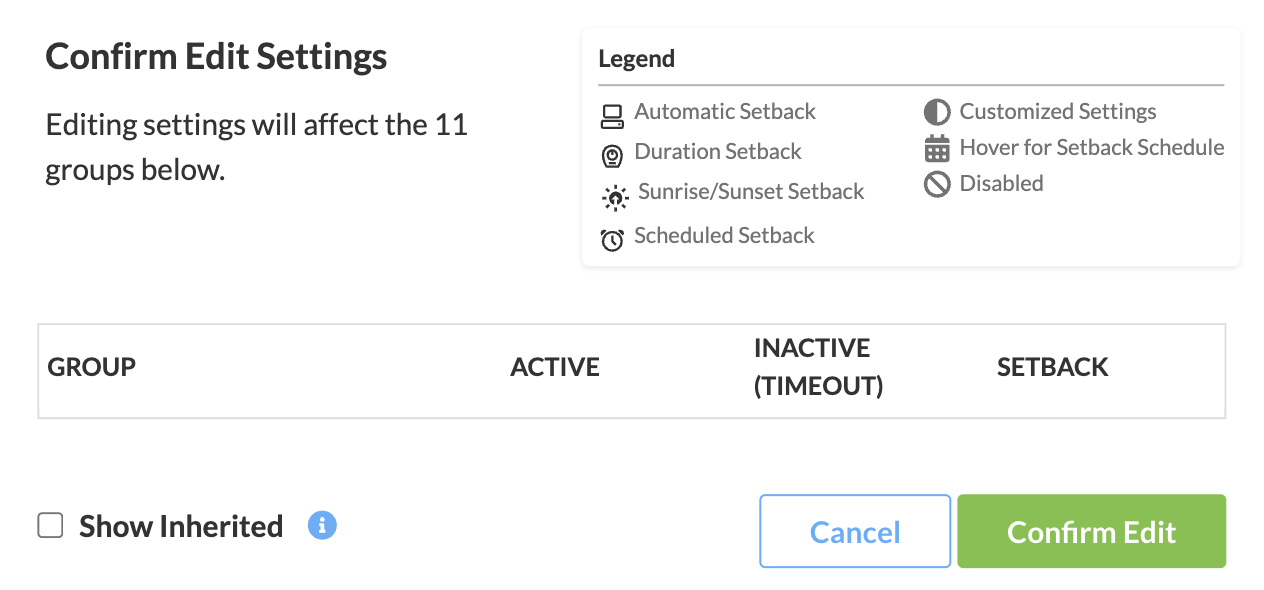
When dimming is disabled for a group, it will be displayed with a 🚫 iconWhen Setback is disabled for a group, it will be displayed with a 🚫 iconIn this example, Child group "Center" is selected, and applied setting changes will result in Customized Settings.
In this example, the Active level has been increased from 90% to 95%. The applied setting change will apply only to Child group "Center". By toggling Show Inherited, you will see the lights that will inherit the applied changes.A ripple animation will play once settings have been successfully applied.
Change Settings for a Single Light

It is strongly advised to place a light in its own group if its settings will be changed frequently to avoid unintentionally affecting other lights in the group.
- Navigate to the SiteWorx Tune Dashboard
- In the Features Application Menu, click the Settings button
- Select the appropriate Area card in the Site containing the groups or fixtures you would like to manage (only applicable to multi-Site Organizations)
- Select a light from the 2-D map or the Settings pane
- Ensure that the light you want to edit is the active editing group. Confirm by checking that only the desired node is colored.
- Click Edit Settingslf the Parent group does not have Customized Settings, clicking Edit Settings will trigger a confirmation pop-up asking you to confirm that you want to proceed with Customized Settings. By toggling Show Inherited, you will see the lights that the Customized Settings will be applied to.
In the Active Level field, use the slider button to set the Active light level
To enable the onboard occupancy sensor for fixture dimming, toggle the Occupancy Sensing slider to the right- In the After section, select the appropriate occupancy timeout
- In the Inactive Level field, use the slider button to set the Inactive light level
To enable Setback, toggle the Setback slider to the right- In the Setback Level field, use the slider button to set the Setback light level
- Select the Setback Mode
- In the After section, select the appropriate occupancy timeout
- Verify that the Unsaved Changes are correct before clicking Apply Settings
- Click Apply Settings. A confirmation pop-up will appear to review your changes
- Click Confirm Apply to confirm the changes
You will be brought to the Area Root group settings by default.In this example, you can see that node "Warehouse - 27" is selected from group "Loading Docks." Editing these settings will result in "Loading Docks" having Customized Settings.
When dimming is disabled for a group, it will be displayed with a 🚫 iconWhen Setback is disabled for a group, it will be displayed with a 🚫 iconIn this example, node "Warehouse - 27" is selected, and applied setting changes will result in Customized Settings.
In this example, the Inactive level has been increased from 10% to 15%. The applied setting change will be passed down to Child groups "Center", "East", and "West". By toggling Show Inherited, you will see the Child groups that will inherit the applied changes. A ripple animation will play once settings have been successfully applied.Node Connectivity
If a node is disconnected from SiteWorx, the settings changes will be applied to the node once it reconnects. If a gateway is disconnected, the yellow banner below will appear after clicking Apply Settings. If the banner appears please check the live device connectivity on the Network page.
Visualizing the Hierarchy
To help you decide which configuration is right for your needs, review the following examples. These scenarios illustrate how the Parent-Child relationship functions in real-world facility layouts, specifically showing how changes to a Parent group flow down to its Children or how a Child can be isolated to meet unique requirements.
Example A - Uniform Settings (Inherited)
In this scenario, Parent Group A is configured with an Active Level of 100%, an Inactive Level of 50%, and a Setback of 0%. Because Child Groups B and C are set to Inherited, they automatically follow Group A's configuration and will enter or exit Setback together.
Example B - Unique Zone Settings (Customized)
In this scenario, Child Group B is modified to have an Inactive Level of 80% while the Parent Group A remains at 50%. This change makes Group A's overall profile Customized. Group B will now operate and enter Setback independently from Group C.